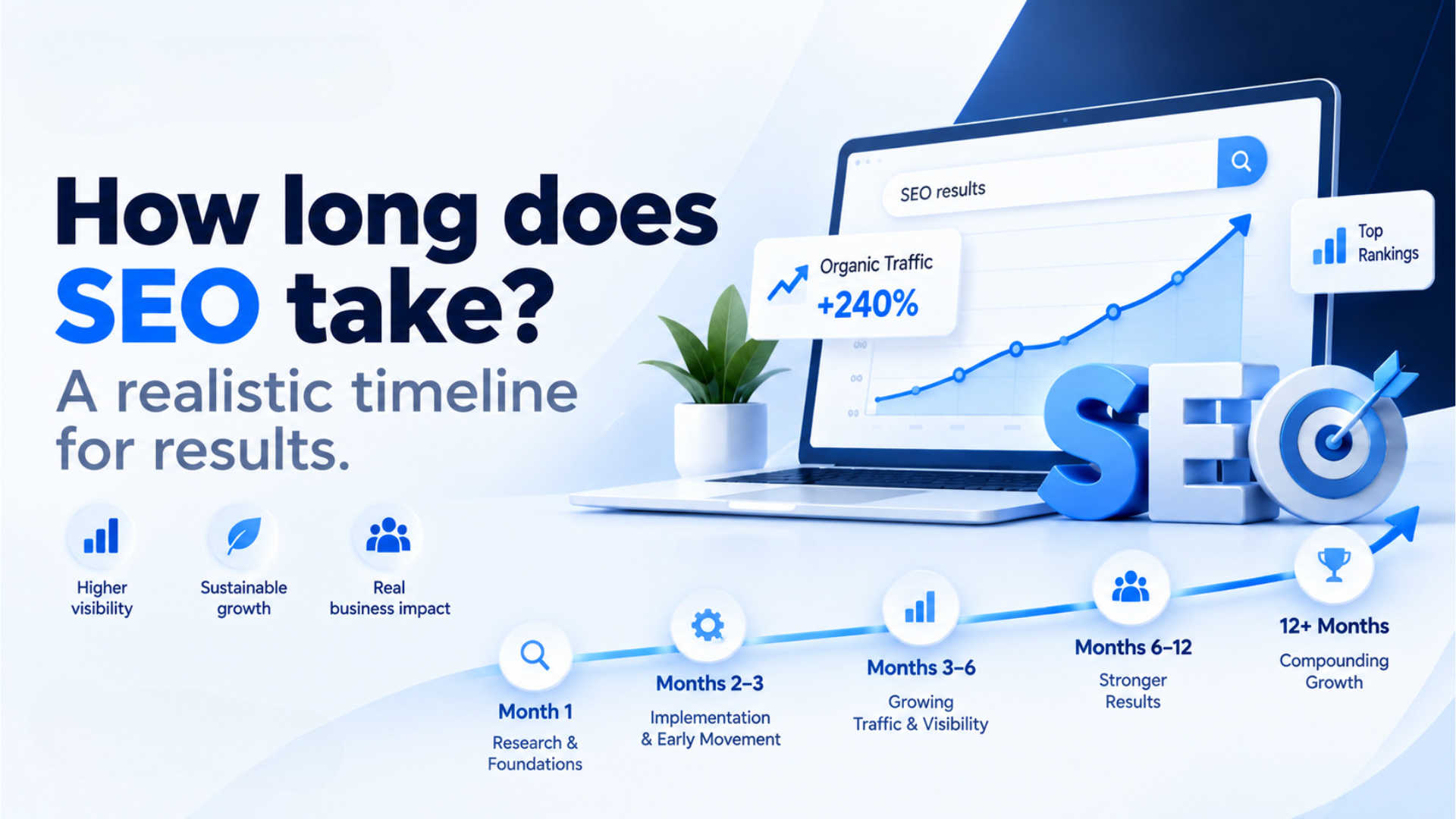
How long does SEO take? For most websites, three to six months is a reasonable planning range for noticeable progress, while meaningful growth in competitive markets can take six to twelve months or longer. That does not mean nothing happens before month three, and it does not mean every website will achieve strong results by month six.
SEO works gradually because search engines need to discover, crawl, understand, and reassess your pages while comparing them with competing results. Google itself says some website changes may be reflected within a few hours, while others can take several months.
The more useful question is therefore not simply “How long does SEO take?” but “What should I expect to happen during that time?”
How long does SEO take to show results?
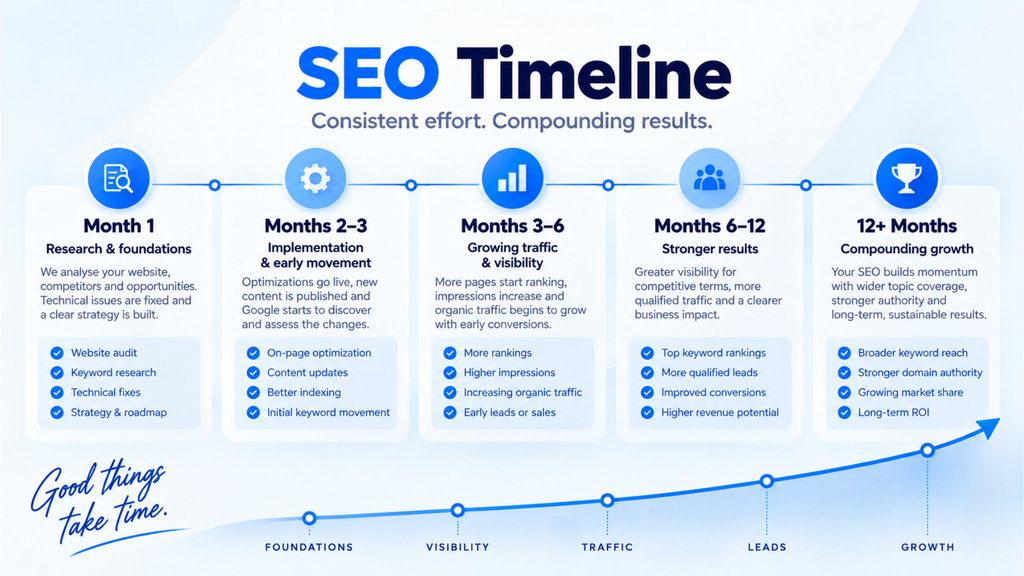
A practical expectation is 3–6 months for measurable SEO progress and 6–12 months for stronger organic traffic, leads, or revenue in more competitive markets. Recent guidance from Search Engine Land, Semrush, SEO.com, and Ahrefs broadly falls around this range, although each stresses that no fixed timeline applies to every website.
The important distinction is what you mean by results. Indexation improvements, additional impressions, or keyword movement may appear much earlier than significant increases in qualified traffic and sales.
A realistic SEO timeline might look like this:
| Time period | What you may start seeing |
| First month | Research, technical fixes, crawling and indexing improvements |
| Months 2–3 | More impressions, initial keyword movement, some early wins |
| Months 3–6 | More rankings, organic traffic growth and early conversions |
| Months 6–12 | Stronger visibility for competitive terms and more commercial impact |
| 12+ months | Greater opportunity for compounding traffic and broader authority |
These are planning ranges, not guarantees. Search Engine Land’s current guide similarly notes that technical or on-page improvements can sometimes create gains within weeks, while sustained organic growth tends to build cumulatively.
Why doesn’t SEO have a fixed timeline?
SEO is not a campaign where you simply switch something on and begin buying traffic. Every website starts from a different position, competes against different businesses, and requires different levels of technical, content, and authority-building work.
Google also evaluates search results continuously. Its documentation explains that some improvements can affect Search within days, while broader reassessment of a site’s helpfulness and reliability may take several months. Google provides no guarantee that a particular change will produce a ranking improvement.
That is why two businesses starting SEO on the same day can experience completely different timelines.
An established website with hundreds of indexed pages and existing authority may improve a poorly optimized page relatively quickly. A completely new domain targeting highly competitive commercial keywords may need significantly more time before it can compete with established businesses.
What does an SEO “result” actually mean?
One reason SEO timelines are confusing is that businesses often use the word results to describe several different outcomes.
For an SEO specialist, an increase in impressions or improved indexing may indicate that the strategy is moving in the right direction. For a business owner, however, the result that matters may be qualified enquiries, bookings, purchases, or revenue. It helps to separate SEO progress into stages.
Visibility
Google begins showing your pages for more relevant searches. This can appear through increasing impressions in Google Search Console even before clicks rise substantially.
Ranking movement
Relevant keywords begin moving into stronger positions. A page might move from outside the top 100 into the top 30 before eventually reaching page-one positions. That movement matters even though it may not immediately produce much traffic.
Organic traffic
As pages reach more visible positions for relevant queries, organic clicks can start increasing. Traffic growth is usually a much more meaningful milestone than simply tracking the number of keywords for which a website appears.
Leads and revenue
The final objective for most businesses is not rankings or traffic alone. SEO becomes commercially valuable when the right visitors arrive on the website and complete actions such as requesting a quote, booking a consultation, calling the business, or purchasing a product.
This distinction matters when setting expectations. A website may show clear SEO progress before that progress becomes noticeable in monthly revenue.
What happens during the first 12 months of SEO?
There is no universal month-by-month formula, but understanding the typical sequence of SEO work makes the timeline easier to evaluate.
Month 1: Research, auditing and foundations
The first month usually focuses on understanding where the website currently stands.
This can involve technical SEO auditing, keyword research, competitor analysis, search intent mapping, analytics configuration, Google Search Console checks, content evaluation, internal-link analysis, and identifying crawling or indexing problems. Critical technical problems may also start being fixed immediately.
If Google cannot crawl important pages correctly, pages are accidentally blocked from indexing, or a website has serious technical issues, addressing those problems can sometimes produce relatively quick improvements. However, those early changes should not be confused with the full return from an SEO strategy.
Months 2–3: Implementation and early movement
Once the initial strategy is established, work usually shifts toward implementation. Important service or product pages may be optimized, internal linking improved, weak content refreshed, new pages created, and technical recommendations deployed.
During this period, Search Console may begin showing encouraging signs such as:
- More organic impressions
- New search queries appearing
- Improved average positions
- More pages receiving clicks
- Better indexing coverage
- Early long-tail rankings
These changes are useful because they show that Google is discovering and reassessing the work being completed. They are not necessarily evidence that the campaign has already reached its commercial potential.
Months 3–6: More meaningful organic growth
This is the period when many SEO campaigns begin producing more visible results. Pages that have been improved or created have had more time to be crawled and evaluated. Internal linking, topical coverage, technical improvements, and authority-building efforts may also start working together rather than as isolated changes.
Industry research frequently places the first meaningful SEO results within this three-to-six-month range. Ahrefs reported that 3–6 months was the most common answer among 3,680 respondents to its polls, while recent Semrush guidance gives a similar general timeframe.
You may begin seeing:
- More keywords entering useful positions
- Existing rankings moving higher
- Increased non-branded organic traffic
- More traffic reaching service or product pages
- Initial organic enquiries or sales
- Content beginning to rank for multiple related searches
The exact pace still depends heavily on competition and the website’s starting point.
Months 6–12: Stronger commercial impact
For businesses competing in established markets, months six through twelve are often where the broader SEO strategy has had enough time to develop meaningful momentum.
Pages have accumulated more historical performance data, topical coverage is broader, technical improvements have been in place longer, and ongoing content and authority-building work can begin reinforcing earlier efforts.
Search Engine Land’s 2026 guide describes 3–6 months as a common range for measurable results while noting that competitive industries may require 6–12 months for significant ranking and revenue impact.
At this stage, businesses should increasingly evaluate SEO through commercial metrics rather than simply rankings.
Relevant questions include:
- Is organic traffic increasing?
- Are important service pages receiving more search traffic?
- Are organic leads increasing?
- Which pages generate conversions?
- Which topics are producing qualified visitors?
- Is the cost of acquiring customers through organic search improving?
These questions tell you much more than asking whether an arbitrary keyword reached position one.
After 12 months: Compounding growth
SEO does not suddenly finish at twelve months. A well-built organic presence can create a compounding effect because existing pages continue attracting traffic while new content expands the number of searches through which potential customers can discover the business.
Older content can also be refreshed, high-performing pages expanded, internal links improved, and new opportunities identified from actual Search Console data. The strategy becomes increasingly informed by evidence rather than initial assumptions.
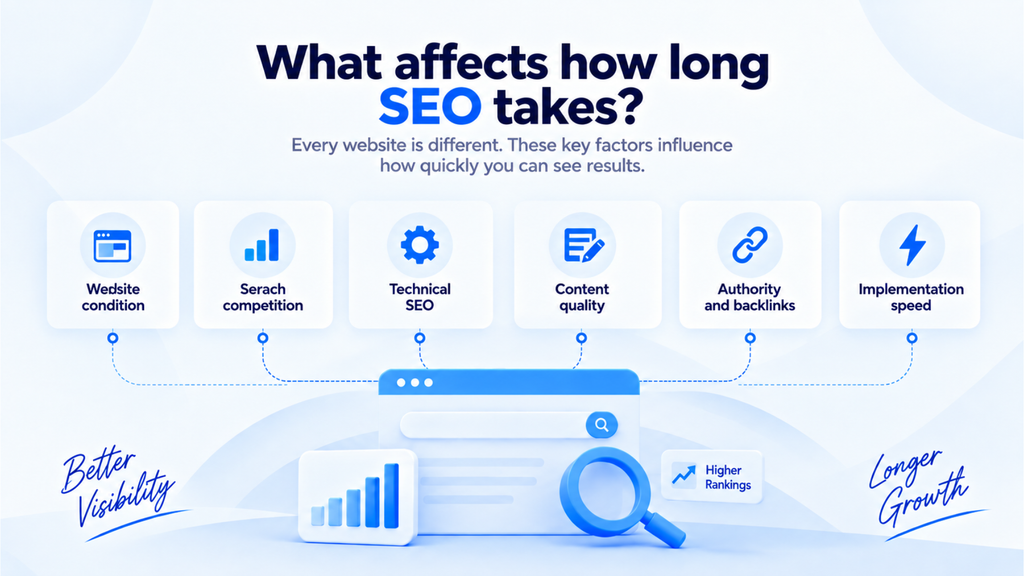
What factors affect how long SEO takes?
The three-to-six-month benchmark is useful for planning, but several variables can move your actual timeline significantly in either direction.
1. Your website’s current condition
An established website that already ranks for hundreds of relevant searches starts from a very different position than a brand-new domain.
Existing websites may already have:
- Indexed pages
- Backlinks
- Organic traffic
- Historical performance
- Brand searches
- Existing keyword rankings
In some cases, improving these existing assets can produce results faster than building visibility from zero.
A newer site generally needs more foundational work before it can compete consistently.
2. Search competition
Trying to rank for an extremely competitive national keyword is different from targeting a specific long-tail or local search.
Consider the difference between:
“SEO agency” and “technical SEO consultant for SaaS websites”
The broader phrase is likely to attract stronger competition from established businesses with extensive websites and strong authority. A more specific query may offer a more realistic opportunity if it closely matches what your business provides.
Search Engine Journal also identifies competition as one of the core variables affecting how long SEO takes.
3. Search intent
Even excellent content can struggle if it does not match what searchers expect to find.
For example, if Google consistently shows detailed educational guides for a keyword, attempting to rank a thin sales page for the same query may be difficult because the page does not satisfy the dominant intent.
Understanding intent before creating or optimizing a page can therefore save months of ineffective work.
4. Technical SEO
Search engines need to be able to discover and process your important pages. Problems involving crawling, indexing, canonicalization, internal linking, redirects, JavaScript rendering, duplicate content, or site architecture can slow progress substantially if they affect important sections of the website.
Google’s SEO Starter Guide emphasizes making it easier for search engines to crawl, index, and understand website content. Fixing technical barriers does not guarantee rankings, but leaving serious barriers unresolved can prevent good content from competing effectively.
5. Content quality and topical coverage
Publishing more pages does not automatically make SEO work faster. Pages need to satisfy genuine search intent and provide useful information. Google specifically advises website owners to focus on helpful, reliable, people-first content rather than content produced mainly to manipulate search performance.
For many businesses, one isolated article is also not enough to establish meaningful visibility around a broad commercial topic. A stronger strategy connects relevant service pages, supporting articles, comparison content, case studies, and other useful resources through a logical internal-linking structure.
6. Authority and backlinks
Links are not the only factor involved in SEO, but strong websites often have significant authority built through years of useful content, brand exposure, partnerships, PR, and relevant backlinks.
A newer business entering the same search results may need time to establish comparable credibility.
That does not mean acquiring as many links as possible as quickly as possible. Relevance, quality, natural acquisition, and overall website value matter far more than chasing arbitrary backlink counts.
7. Implementation speed
An SEO strategy cannot produce results if recommendations sit in a spreadsheet for four months. This is one of the most overlooked factors affecting SEO timelines.
Imagine an audit identifies:
- Broken internal links
- Incorrect canonical tags
- Weak service-page content
- Poor title tags
- Missing location pages
- Slow templates
- Important content gaps
One company implements the changes within two weeks. Another requires approval from development, compliance, management, and content teams and finally publishes the changes four months later.
Both companies may have received the same SEO recommendations, but their effective SEO timelines are very different.
8. Available resources
Resources influence how much useful work can be completed. A company able to combine SEO strategy, development, content production, design, digital PR, and analytics can often address opportunities more quickly than a business where one person handles everything.
That does not mean a large budget automatically buys rankings. Google does not sell organic positions. Resources simply affect how quickly a business can research, create, implement, measure, and improve good SEO work.
How long does SEO take for a new website?
New websites often require more patience because they have limited search history, fewer indexed pages, fewer relevant links, and little existing organic visibility.
During the first few months, the priority should usually be building strong foundations rather than obsessing over individual rankings. That means ensuring important pages are crawlable, developing useful service or product content, targeting realistic search opportunities, establishing internal linking, and publishing supporting content where demand exists.
A new website can still achieve early rankings for specific or less competitive queries. The mistake is assuming those early wins mean the website should also rank quickly for highly competitive commercial terms.
How long does SEO take for an established website?
An established website may see some improvements considerably faster, particularly when existing pages already rank reasonably well.
For example, a page sitting between positions 8 and 20 might improve after better aligning with search intent, filling important content gaps, strengthening internal links, or resolving technical problems. That does not mean every established website has an advantage.
Years of poor architecture, duplicated content, outdated pages, migration mistakes, or technical debt can make an older website more complicated than starting with a cleaner new site. Website age alone is therefore not a useful SEO strategy.
Does local SEO work faster?
Local SEO can sometimes produce noticeable movement sooner than highly competitive national SEO because the competitive set may be smaller and location relevance narrows the search landscape.
A specialist business targeting a particular town may have fewer direct competitors than a company attempting to rank nationally for a broad service keyword. However, local SEO is not automatically easy.
Competitive cities and industries such as legal services, dentistry, property, home services, and finance can have very strong local competition. Google Business Profile optimization, reviews, website relevance, local landing pages, citations, links, and proximity may all influence visibility. Treat local SEO as a different competitive environment, not as a guaranteed shortcut.
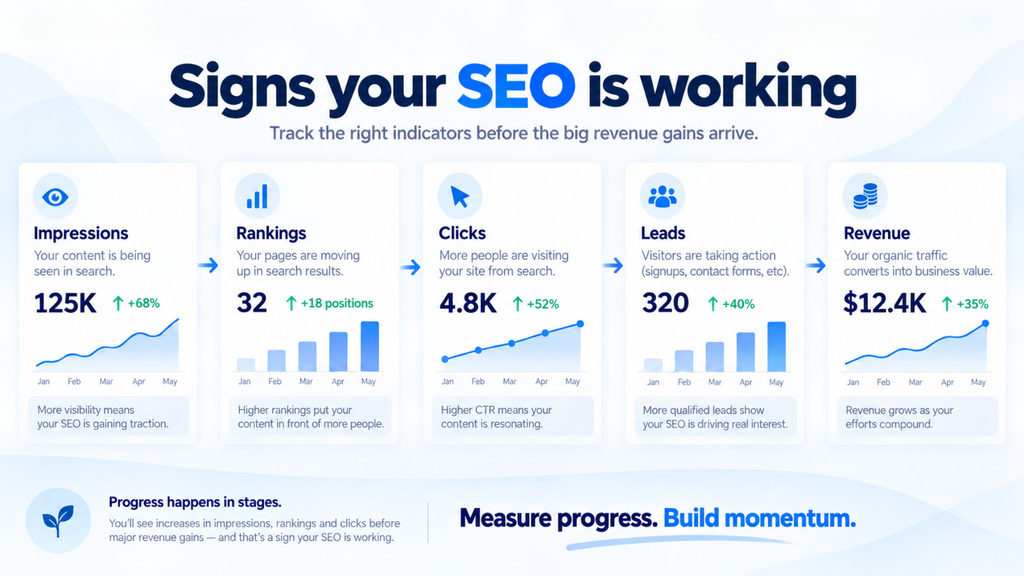
How can you tell whether SEO is working before traffic grows?
Waiting six months and only then checking organic traffic is a poor way to manage an SEO campaign. Good SEO reporting looks for leading indicators that show whether visibility is developing.
Google Search Console is particularly useful because it lets website owners evaluate clicks, impressions, queries, pages, countries, and changes in search performance over time.
Useful early indicators include:
- More relevant pages being indexed
- Growing search impressions
- New non-branded queries appearing
- Important keywords moving closer to page one
- More pages receiving organic clicks
- Growth in long-tail search visibility
- Increasing clicks to commercial pages
- Improvements in organic conversions
None of these should be viewed in isolation. A business could gain thousands of impressions for irrelevant informational keywords without generating a single useful lead. SEO performance should gradually connect visibility to qualified traffic and ultimately business outcomes.
What can make SEO take longer?
Slow SEO is not always caused by Google. Many delays come from the strategy or implementation itself.
Common problems include:
- Targeting keywords that are unrealistically competitive
- Creating content without understanding search intent
- Publishing large amounts of weak or repetitive content
- Ignoring technical problems
- Poor internal linking
- Slow development implementation
- Failing to update outdated pages
- Focusing on vanity metrics
- Building low-quality backlinks
- Frequently changing strategy before enough data exists
- Expecting every page to rank immediately
Another common problem is doing SEO inconsistently. Publishing three articles, stopping for four months, fixing a few pages, and then changing direction makes it difficult to build momentum or evaluate which actions actually worked.
Can you make SEO work faster?
You cannot force Google to rank a page, but you can avoid unnecessary delays. Start by fixing obstacles that prevent existing value from being recognized.
Prioritize pages already close to performing
Pages ranking just outside strong organic positions may offer quicker opportunities than creating entirely new content. Review existing pages with impressions and positions that suggest Google already considers them relevant.
Then determine whether better search-intent alignment, content improvements, internal links, titles, or other changes could make the page more competitive.
Fix major technical issues first
A technically perfect website will not automatically rank. However, spending months publishing content while important sections of the site cannot be indexed properly makes little sense. Resolve critical crawl and indexation problems early.
Target realistic opportunities
Your keyword strategy should reflect the website you have today, not the website you hope to become three years from now. Combine competitive long-term targets with more specific queries where your business can genuinely offer one of the strongest answers.
Strengthen internal linking
Internal links help users and search engines discover related content and understand relationships between pages. Connect supporting articles to appropriate service or product pages where the relationship genuinely helps the reader. Do not add dozens of repetitive links simply because an SEO tool recommends increasing link counts.
Improve existing content before endlessly publishing
Many websites already contain pages with some search visibility but weak performance. Updating those assets may be more valuable than producing another article targeting a nearly identical topic. Review what Google already associates with your website before expanding the content library.
Implement recommendations quickly
Good strategy combined with slow execution still produces slow results. If developers, writers, designers, or stakeholders are involved, establish a clear process for turning recommendations into live changes. SEO time should be measured from implementation, not from the day an audit document was delivered.
Can SEO work in 30 days?
You can absolutely see SEO changes within 30 days, but expecting complete SEO success within one month is unrealistic for most competitive websites. Google states that some changes can appear within hours, while others may require several months.
Within the first month you might see improved indexing, increased impressions, ranking movement, or gains from pages that were already close to performing. What you should be cautious of is anyone guaranteeing that a new business will achieve top rankings for highly competitive keywords within 30 days. Organic rankings cannot simply be purchased or guaranteed.
How long does it take to rank number one on Google?
There is no reliable timeline for reaching position one. In fact, ranking number one should rarely be treated as the sole measure of SEO success.
Different queries have different competitive environments, search results constantly change, and Google’s systems continuously reassess pages. Google explicitly states that search positions are not static and that website improvements do not guarantee a particular result.
A better objective is improving visibility across a commercially relevant group of searches and measuring whether those searches generate useful business outcomes.
When is slow SEO progress a warning sign?
Patience matters in SEO, but “SEO takes time” should never become an excuse for a campaign with no evidence of progress. After several months, you should be able to understand what has actually been implemented and what indicators are changing.
Warning signs include:
- No clear strategy or keyword mapping
- Important technical recommendations remain unresolved
- No measurable growth in relevant impressions
- Reports focus only on irrelevant keyword counts
- Content is published without a clear purpose
- Nobody can explain why particular pages are being created
- Conversion tracking is missing
- The strategy never changes despite clear evidence that it is not working
- Guaranteed ranking promises are used instead of measurable objectives
Slow commercial growth can be perfectly normal. A complete absence of strategy, implementation, measurement, and early indicators is different.
Does SEO stop once you get results?
No. SEO is better treated as an ongoing growth channel than a one-off project. Competitors publish new content, products change, customer search behavior evolves, websites accumulate technical issues, and search engines continually update their systems.
Existing high-performing content can also become outdated. Continued SEO work might therefore include refreshing important pages, expanding topical coverage, improving conversion paths, strengthening internal linking, fixing technical issues, earning relevant mentions, and responding to new search opportunities.
The objective should eventually shift from “How quickly can we rank?” to “How consistently can organic search contribute to profitable growth?”
So, how long should you give SEO?
For planning purposes, expect roughly three to six months before judging meaningful SEO progress and six to twelve months for stronger commercial results in competitive markets.
That range should never be treated as a guarantee. A technically sound established website targeting realistic opportunities may move faster, while a new website entering a highly competitive market can take considerably longer.
More importantly, do not spend six months waiting blindly. Track impressions, relevant rankings, clicks, organic landing-page performance, conversions, and implementation progress from the beginning. A good SEO strategy should provide evidence that it is moving in the right direction before it reaches its full commercial potential.
Frequently asked questions
How long does SEO take to work for a new website?
A new website may begin gaining impressions and rankings within its first few months, but meaningful organic growth commonly takes longer. New sites usually need time to establish useful content, technical foundations, search visibility, and authority. Highly competitive commercial terms may require considerably more time than specific long-tail searches.
Can SEO show results in one month?
Yes, certain SEO improvements can show an effect within one month, especially on an established website or where technical problems are corrected. Google says some changes can be reflected within hours while others can take several months. One month is therefore possible for early movement, but it is not a realistic universal deadline for full SEO success.
Why does SEO take three to six months?
SEO often requires multiple improvements to work together, including technical optimization, content, internal linking, search-intent alignment, and authority development. Search engines also need time to crawl and reassess those changes against competing pages. The three-to-six-month range is an industry planning benchmark rather than a rule enforced by Google.
How do I know if SEO is working?
Look beyond headline keyword rankings. Growing relevant impressions, stronger positions, increased non-branded clicks, more organic landing pages receiving traffic, and rising organic conversions are more useful indicators. Google Search Console can help track queries, impressions, clicks, pages, and search-performance changes over time.
How long should I pay for SEO before expecting results?
There is no universal contract length that guarantees results. Businesses should instead agree on realistic milestones, confirm that recommended work is actually being implemented, and monitor leading indicators during the first few months. For competitive markets, evaluating meaningful commercial performance over a six-to-twelve-month horizon is generally more realistic than judging an SEO program after a few weeks.
Leave a Reply