SEO vs PPC comes down to how quickly you need results, how you want to spend your marketing budget, and whether you are prioritising short-term visibility or long-term organic growth. SEO focuses on earning visibility in unpaid search results, while PPC allows you to pay for ad placements and attract traffic much more quickly.
Neither is universally better. PPC can put your business in front of potential customers almost immediately, while SEO builds search visibility that can continue generating traffic without paying for every click. For many businesses, the strongest strategy is not choosing between them but understanding when and how to use both.
SEO vs PPC: What is the difference?
SEO, or search engine optimization, improves your website’s visibility in organic search results. PPC, or pay-per-click advertising, lets you advertise within paid placements and pay when users interact with your ads, depending on the campaign and bidding model.
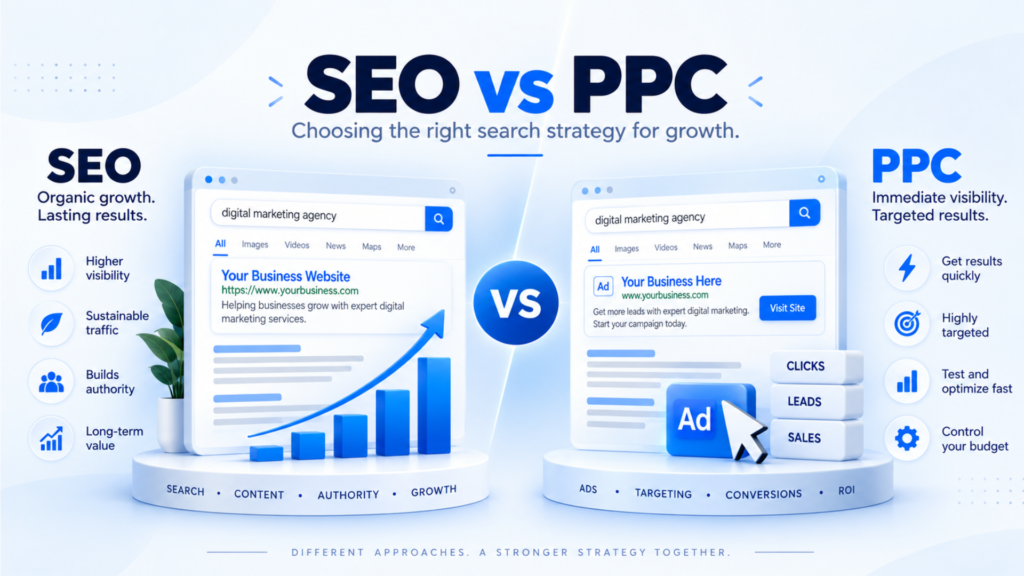
The simplest distinction is this:
| Factor | SEO | PPC |
| Search visibility | Organic | Paid |
| Payment per click | No | Usually yes for search PPC |
| Speed | Gradual | Potentially immediate |
| Traffic after spending stops | Can continue | Usually stops |
| Targeting control | More limited | Highly controllable |
| Long-term value | Can compound | Depends on continued spend |
| Testing speed | Slower | Faster |
| Main platform | Organic search | Google Ads, Microsoft Ads and others |
| Best suited for | Sustainable growth | Immediate demand capture |
Google does not accept payment to rank pages higher in its organic search results. Organic visibility depends on how Google discovers, understands, evaluates and serves content rather than how much an advertiser spends.
What is SEO?
SEO stands for search engine optimization. It involves improving a website so search engines can understand its content and users can discover relevant pages when searching.
Google describes SEO as helping search engines understand your content and helping users find your site through search.
SEO normally involves several areas.
Technical SEO
Technical SEO helps search engines access, crawl, understand and index your website correctly.
Typical work can include:
- Improving crawlability and indexability
- Fixing broken internal links
- Managing canonical tags
- Creating XML sitemaps
- Improving website speed and usability
- Implementing structured data where appropriate
- Maintaining a mobile-friendly website
On-page SEO
On-page SEO improves individual pages to make their purpose clearer to search engines and visitors.
This commonly includes:
- Search intent research
- Keyword targeting
- Titles and meta descriptions
- Heading structure
- Content optimisation
- Internal linking
- Image optimisation
- Topical coverage
Content SEO
Content SEO focuses on creating pages that answer the questions potential customers are actually searching for.
Depending on the business, this might include service pages, comparison pages, buying guides, how-to articles, case studies, category pages and supporting educational content.
Off-page SEO
Off-page SEO focuses on signals and exposure beyond your website, including earning relevant backlinks, digital PR, brand mentions and authority within your market.
How does SEO work?
Search engines discover pages, process their content and determine which pages may be relevant for particular searches.
Google explains that its systems evaluate numerous factors when serving results, including relevance to the query and contextual information such as location, language and device. Successful SEO therefore is not simply about inserting keywords into a page.
A strong SEO strategy considers:
- What the user is actually searching for.
- Whether your website has the right page for that intent.
- Whether search engines can access and understand the page.
- Whether the content provides sufficient value.
- Whether your website demonstrates relevance and credibility around the subject.
- Whether visitors can easily take the next step.
Advantages of SEO
SEO can produce sustainable traffic
A page that earns strong organic visibility can continue attracting visitors without the business paying a fee every time someone clicks it. That does not mean SEO is free. Content production, technical work, tools, strategy, development and link acquisition can all require investment.
The difference is the cost model. SEO invests in improving assets you own, while PPC generally requires continuing media spend to maintain paid traffic.
SEO can reduce dependence on paid traffic
Businesses that rely completely on advertising must continue buying traffic. Strong organic visibility can create another customer acquisition channel and reduce the risk of depending entirely on paid campaigns.
SEO supports the entire customer journey
Not everyone is ready to purchase when they first search. SEO can target queries across different stages, including:
Awareness:
“What is technical SEO?”
Consideration:
“SEO vs PPC”
Commercial investigation:
“best SEO agencies”
Transactional:
“SEO agency near me”
A strong organic strategy therefore does more than rank a homepage. It creates visibility across the customer’s research process.
Organic visibility can compound
One well-optimised page may rank for many related searches. Add more useful pages, improve internal linking and strengthen topical coverage, and the overall organic footprint of the website can grow. This compounding effect is one of SEO’s biggest advantages.
Disadvantages of SEO
SEO takes time
SEO is rarely the best channel when you need meaningful search traffic immediately. New pages have to be discovered and evaluated, competitive queries require stronger websites and content, and improvements do not guarantee a specific ranking.
Google explicitly states that there is no guarantee a website will be indexed or achieve a particular position. Many current industry comparisons describe SEO results as developing over months rather than days, but any fixed timeline should be treated as an estimate rather than a guarantee.
You have less control
With PPC, you can decide which keywords, locations, audiences and campaigns receive budget. SEO offers less direct control. You can optimise a page for a query, but you cannot purchase the organic ranking you want.
SEO requires ongoing work
Achieving a ranking does not mean the job is finished. Competitors improve their websites, search behavior changes, content becomes outdated and search engines continue evolving. Sustainable SEO therefore requires monitoring and improvement.
What is PPC?
PPC stands for pay-per-click. In search marketing, it usually refers to advertising platforms such as Google Ads and Microsoft Advertising where businesses can bid to appear for relevant searches. With CPC bidding in Google Ads, advertisers generally pay when someone clicks their ad rather than simply when the ad is displayed.
For example, imagine a business wants to appear when someone searches:
Digital marketing agency
The business could create a Google Ads search campaign, target relevant keywords and compete for paid visibility. How much the business ultimately pays can vary based on the auction, competition, bid, ad quality, relevance and other factors.
Advantages of PPC
PPC can generate visibility quickly
One of PPC’s greatest advantages is speed. Instead of waiting for an organic page to gain visibility, businesses can potentially start receiving impressions and clicks once campaigns are set up, eligible and running.
That makes PPC particularly useful for:
- New businesses
- Product launches
- Limited-time promotions
- Seasonal campaigns
- New service launches
- Immediate lead-generation campaigns
You have greater targeting control
PPC gives advertisers significant control over how campaigns operate. Depending on the platform and campaign type, businesses can manage factors such as keywords, geographic areas, devices, schedules, bids, budgets and audiences. That makes PPC useful when your target market is clearly defined.
PPC provides faster testing
Imagine you are unsure whether customers respond better to:
“Affordable SEO services”
or:
“SEO focused on increasing qualified leads”
Testing both through organic search could take considerable time. Paid campaigns allow businesses to test offers, landing pages, queries and messaging much faster. The resulting conversion data can then inform broader marketing decisions.
Budgets can be controlled
Google Ads lets advertisers establish campaign budgets and bidding strategies. Businesses can increase, decrease or pause campaigns depending on performance and objectives. However, having budget controls does not automatically make a campaign profitable. Conversion tracking, landing-page quality, targeting and campaign management still matter.
Disadvantages of PPC
Traffic depends on advertising spend
The biggest difference between PPC and SEO appears when spending stops. A PPC campaign needs budget to continue buying paid traffic. SEO pages may continue receiving organic traffic after the initial investment, although their performance can also rise or decline over time.
Competitive clicks can become expensive
There is no universal Google Ads cost per click. Google explains that advertising costs vary and that keyword competition, bids, relevance and expected performance can influence pricing. Industries with high-value customers can therefore have expensive search auctions.
This makes unit economics important. Paying £10 for a click might be excellent if one customer is worth thousands of pounds. Paying £2 per click might be unprofitable if your product only generates a few pounds in margin.
Cost should always be evaluated against customer value, not in isolation.
Poor campaigns can waste money quickly
PPC’s speed works in both directions. A strong campaign can collect useful data quickly. A poorly structured campaign can also spend money quickly.
Common causes include:
- Weak keyword targeting
- Irrelevant search terms
- Poor landing pages
- Missing conversion tracking
- Weak ad messaging
- Incorrect location targeting
- Bidding toward the wrong objective
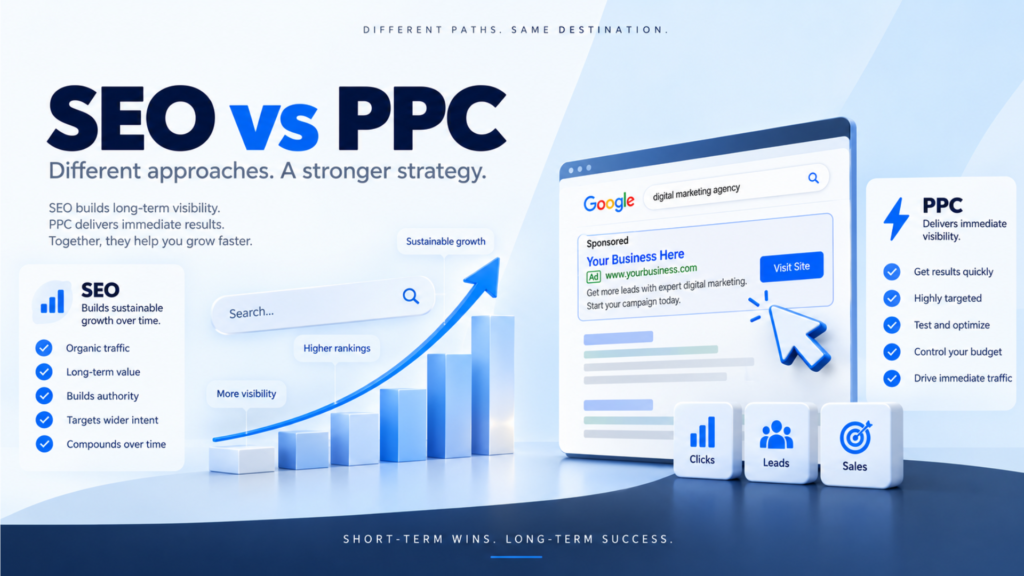
SEO vs PPC: Which delivers results faster?
PPC generally wins on speed.
A paid search campaign can begin generating visibility soon after it becomes active and eligible.
SEO normally requires more time because search engines must discover, understand and evaluate your pages, while your website may also need stronger content, technical improvements or authority.
If your company launches a service on Monday and needs enquiries this week, PPC is usually the more practical search channel.
If you want to build a reliable source of organic acquisition over the coming months and years, SEO becomes increasingly important.
SEO vs PPC: Which is cheaper?
Neither channel is automatically cheaper. SEO does not charge you for every organic click, but successful SEO still requires resources.
You may need to pay for:
- SEO specialists
- Content writers
- Developers
- Digital PR or outreach
- SEO software
- Design
- Website improvements
PPC has a more direct traffic cost because advertisers pay for advertising interactions, including clicks in common search campaign models.
The better question is:
Which channel produces customers at an acceptable acquisition cost?
Suppose:
SEO
Annual investment: £24,000
Leads generated: 400
Customers acquired: 80
Customer acquisition cost:
£24,000 ÷ 80 = £300
Now consider:
PPC
Annual investment including media and management: £36,000
Leads generated: 600
Customers acquired: 120
Customer acquisition cost:
£36,000 ÷ 120 = £300
Despite PPC costing more overall, both channels produced the same acquisition cost in this example.
This is why marketers should avoid declaring one channel cheaper without considering actual business results.
SEO vs PPC: Which provides better ROI?
There is no universal answer.
ROI depends on factors such as:
- Industry
- Competition
- Website quality
- Conversion rate
- Customer lifetime value
- Keyword intent
- Campaign management
- Sales process
- Attribution
- Measurement period
SEO often becomes attractive over longer measurement periods because traffic does not carry a direct per-click fee.
PPC can deliver excellent ROI when businesses understand their customer economics and target high-intent searches efficiently.
Instead of asking which channel has the better ROI globally, compare your own revenue and acquisition costs from each channel.
When should you choose SEO?
SEO is usually the stronger priority when you want to build sustainable organic visibility.
Consider prioritising SEO when:
- Customers consistently search for your services
- You have a long-term growth strategy
- You want to reduce reliance on advertising
- You can invest before expecting full returns
- Educational search demand exists in your market
- You want to build topical visibility around multiple customer problems
- Your paid search market is expensive
- Content can influence customers throughout their buying journey
For example, a digital marketing agency could build organic visibility around searches such as:
“SEO audit”
“how much does SEO cost?”
“SEO vs PPC”
“technical SEO checklist”
“SEO agency”
Each page addresses a different stage of potential customer intent.
When should you choose PPC?
PPC is usually the stronger option when timing, targeting and rapid testing matter most.
Consider PPC when:
- You need leads quickly
- You are launching something new
- You have a time-sensitive promotion
- You already know your customer value
- High-commercial-intent keywords are available
- You need precise geographic targeting
- You want to validate demand
- You want to test landing pages or messaging quickly
For example, a newly launched service could use PPC to generate immediate search visibility while an SEO strategy develops in parallel.
Should a new business use SEO or PPC first?
For many new businesses, using both strategically makes more sense than committing completely to one channel.
PPC can help answer immediate questions:
- Which searches generate enquiries?
- Which offers attract clicks?
- Which landing pages convert?
- Which services have strong commercial demand?
At the same time, SEO can begin building pages around relevant, sustainable search opportunities. Over time, the company becomes less dependent on a single acquisition source.
Can SEO and PPC work together?
Yes. In many cases, SEO and PPC are more valuable together than separately.
Google itself suggests reframing the question from “SEO vs PPC” to “SEO and PPC” because the channels perform different jobs.
Here are several practical ways to combine them.
Use PPC to test commercial keywords
SEO can require considerable resources before a page earns meaningful visibility.
PPC can provide faster evidence about whether particular search terms generate conversions.
High-performing themes can then inform your organic content strategy.
Use SEO for queries that repeatedly consume paid budget
If certain evergreen topics consistently attract valuable prospects, building strong organic pages around those searches can make sense. This does not mean immediately turning off paid campaigns when organic rankings improve. Measure the combined effect first.
Use PPC while SEO develops
A new website may have little organic visibility.
Paid search can capture existing demand while SEO work gradually expands organic reach.
Cover more of the search journey
PPC may focus heavily on high-intent commercial searches.
SEO can extend coverage into informational and comparison searches where potential buyers are still researching.
Together, the channels can reach users at more stages of the decision-making process.
Does running PPC improve SEO rankings?
No. Paying Google for advertising does not buy better organic rankings.
Google explicitly states that it does not accept payment to rank sites higher in organic search results. Google Ads can still support your broader marketing strategy by providing search and conversion data, generating traffic and helping you test offers.
But advertising spend itself does not make your organic rankings increase. This distinction matters because businesses should never pay an agency that claims Google Ads spending will directly purchase higher organic rankings.
SEO vs PPC for different business goals
| Business objective | Better starting point |
| Need traffic immediately | PPC |
| Build long-term search visibility | SEO |
| Launch a new product or service | PPC |
| Capture informational searches | SEO |
| Test keyword demand | PPC |
| Build an organic content moat | SEO |
| Promote a short-term offer | PPC |
| Reduce long-term dependence on ads | SEO |
| Dominate important search opportunities | SEO + PPC |
| New website needing both short and long-term growth | SEO + PPC |
These are starting points rather than absolute rules.
Your conversion data and customer economics should ultimately determine where additional budget goes.
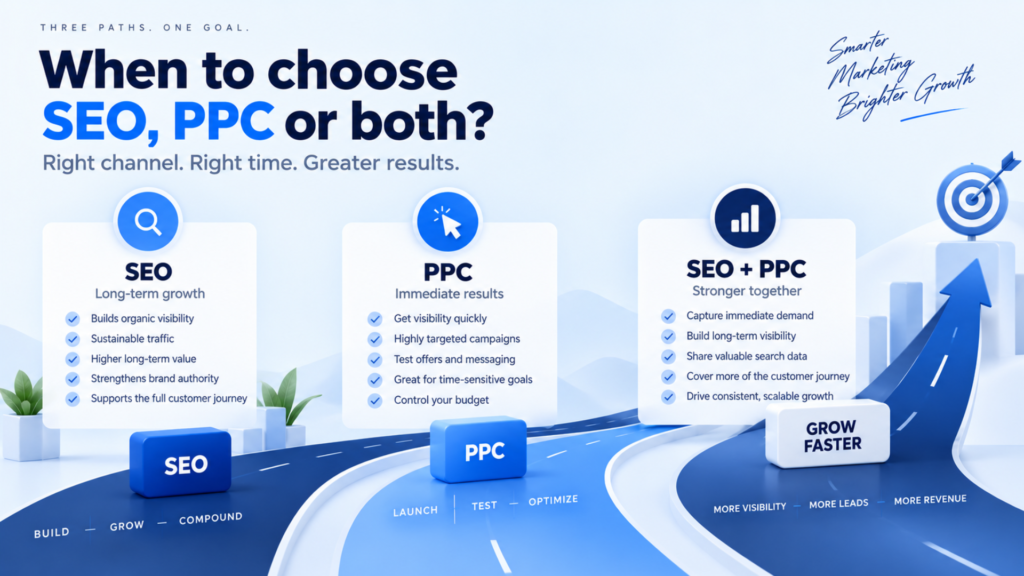
How to decide between SEO and PPC
Instead of asking which channel is “better,” answer five questions.
1. How quickly do you need results?
If the answer is days or weeks, PPC deserves serious consideration. If you can invest over a longer period, SEO can build a more durable acquisition channel.
2. Is there existing search demand?
SEO works best when people are already searching for topics relevant to your product, service or customer problem. Keyword research can reveal whether that demand exists. PPC can also help validate commercial demand more quickly.
3. What is a customer worth?
This is essential for paid advertising. If your average customer generates £5,000 in profit, you can potentially afford a much higher acquisition cost than a business earning £20 per customer.
Calculate:
Customer acquisition cost = Total acquisition spend ÷ New customers
Then compare your acquisition cost with the value those customers generate.
4. How competitive are the search results?
Organic competition and PPC competition are different. A keyword might have expensive ad clicks but achievable organic competition. Another might have relatively affordable paid traffic but organic results dominated by exceptionally authoritative websites. Analyze both channels separately.
5. What happens if one channel disappears?
Businesses relying entirely on paid search are exposed when advertising costs become unprofitable. Businesses relying entirely on SEO are exposed when rankings decline. Diversification creates resilience.
For many established businesses, the eventual goal should therefore be a profitable search strategy, not allegiance to one channel.
Which metrics should you track?
SEO and PPC should not be evaluated using identical metrics.
Important SEO metrics
Monitor:
- Organic clicks
- Organic impressions
- Relevant keyword visibility
- Organic conversions
- Conversion rate
- Leads or sales
- Revenue from organic search
- Organic landing-page performance
Google Search Console can help businesses understand how pages perform within Google Search.
Important PPC metrics
Monitor:
- Impressions
- Clicks
- Click-through rate
- Average CPC
- Conversions
- Conversion rate
- Cost per conversion
- Revenue
- Return on ad spend
Google Ads defines average CPC as total click cost divided by the number of clicks.
Business metrics matter most
Channel metrics are useful, but the final evaluation should come back to business performance.
Ask:
- How much did we spend?
- How many qualified opportunities did we generate?
- How many became customers?
- How much revenue and profit did they produce?
- Which channel generated the best customers?
That produces a much stronger SEO vs PPC decision than simply comparing traffic.
Common SEO vs PPC mistakes
Treating SEO traffic as free
Organic clicks do not carry a direct Google Ads charge. SEO itself still requires resources. Include staff, agency, content, development and tool costs when measuring performance.
Judging SEO too early
SEO performance should not be evaluated using the same time horizon as paid advertising. A campaign can begin collecting PPC data quickly, while organic improvements typically require more patience.
Running PPC without conversion tracking
Clicks are not the objective for most businesses. Leads, purchases, bookings, calls or other valuable actions are. Without reliable conversion measurement, optimizing paid advertising becomes much harder.
Chasing traffic instead of commercial relevance
The keyword with the highest search volume is not necessarily the keyword with the greatest business value. A smaller keyword with stronger purchasing intent can generate significantly more valuable enquiries. This applies to both SEO and PPC.
Keeping SEO and PPC teams completely separate
Search data becomes more valuable when teams communicate. PPC teams may discover converting queries that deserve organic attention. SEO teams may discover long-tail opportunities or landing-page themes worth testing through paid search.
SEO vs PPC: Which one should you choose?
Choose PPC when you need speed, precise targeting, rapid testing or immediate visibility. Choose SEO when you want to build sustainable organic visibility, develop search authority and attract visitors without paying for every organic click.
Choose SEO and PPC together when search is an important customer acquisition channel and you want both immediate demand capture and long-term growth. That third option will make the most sense for many established businesses.
PPC can answer what works now. SEO can turn validated search demand into a longer-term acquisition asset.
Final thoughts
The SEO vs PPC decision should not be reduced to “free traffic versus paid traffic.”
SEO requires investment but can create organic visibility that continues generating value over time. PPC requires continued advertising spend but provides speed, control and rapid market feedback. Start by defining your business objective.
If you need enquiries quickly, PPC may deserve the first portion of your budget. If sustainable search visibility is the priority, SEO should be central to your strategy. If you want a stronger overall search presence, use both channels strategically and allow real conversion data to determine where your next pound should go.
For Google’s own explanation of how SEO and PPC differ, see the official Google Ads guide: Google’s SEO vs PPC guide
Frequently asked questions
Is SEO better than PPC?
Neither is automatically better. SEO is generally more suitable for building long-term organic visibility, while PPC is more suitable when businesses need immediate paid visibility and greater campaign control. Many businesses benefit from combining both.
Is SEO cheaper than PPC?
SEO does not charge businesses for each organic click, while PPC commonly involves paying for clicks. However, SEO still requires investment in strategy, content, technical optimisation and other resources. Compare customer acquisition cost and revenue rather than assuming one channel is always cheaper.
Does PPC help SEO rankings?
No. Paying for Google Ads does not directly improve your organic Google rankings. Google states that payment does not influence organic ranking positions.
Can SEO and PPC be used together?
Yes. PPC can provide fast data about keywords, messaging and conversions, while SEO can build sustainable organic visibility around valuable search topics. Using both can create a more diversified search strategy.
How long does SEO take compared with PPC?
PPC can potentially begin producing traffic soon after a campaign is activated. SEO normally takes longer because pages must be crawled, indexed, evaluated and become competitive within organic search. There is no guaranteed SEO timeline, and results depend on the website, market and competition.
Leave a Reply