
For businesses researching SEO cost UK pricing, a realistic starting point in 2026 is around £500 to £5,000+ per month for ongoing professional SEO. Small local campaigns can sit towards the lower end, while competitive national, ecommerce and enterprise campaigns can cost considerably more.
Current UK pricing guides show just how wide the market is, with the final price depending on your competition, website condition, target locations, content requirements and the amount of specialist work involved. The important point is that SEO does not have a standard UK price.
A £600 SEO package and a £4,000 monthly retainer are rarely two prices for exactly the same service. They usually represent very different amounts of strategy, technical work, content production, authority building and specialist time.
This guide explains what SEO costs in the UK, what different budgets can realistically buy, why quotes vary so much and how to decide what your own business should spend.
SEO cost UK at a glance
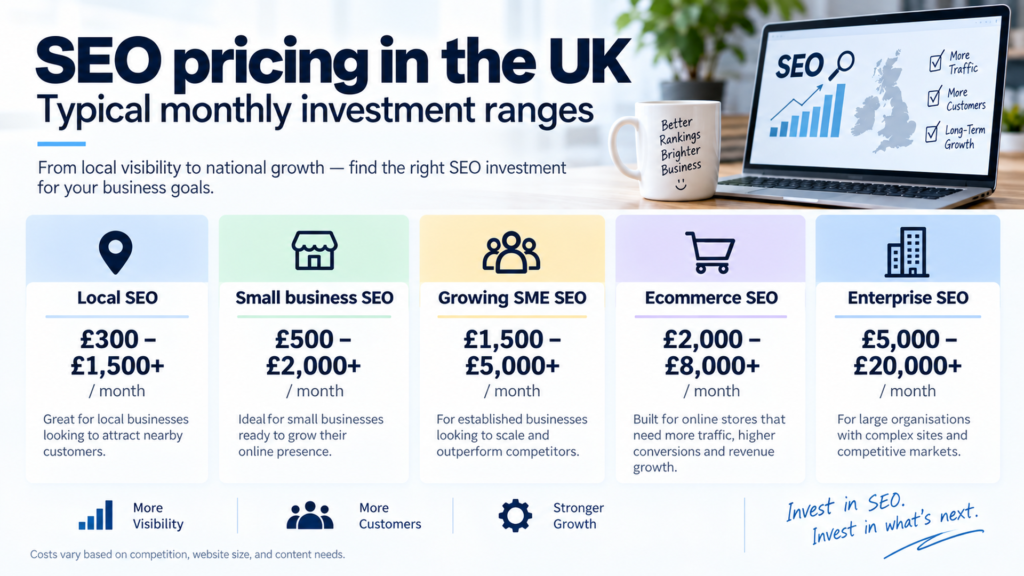
Here is a practical overview of common UK SEO pricing based on the current market guides reviewed for this article.
| SEO service or campaign | Typical indicative cost |
| Basic/local SEO | £300 to £1,000+ per month |
| Small business SEO | £500 to £2,000+ per month |
| Growing SME SEO | £1,500 to £5,000+ per month |
| Competitive national SEO | £3,000 to £8,000+ per month |
| Ecommerce SEO | £2,000 to £8,000+ per month |
| Enterprise SEO | £5,000 to £20,000+ per month |
| SEO freelancer | Roughly £40 to £100+ per hour |
| Specialist SEO consultant | Roughly £75 to £300+ per hour |
| One-off SEO audit | Around £500 to £5,000+, depending on complexity |
| Large technical or migration project | Several thousand pounds and potentially much more |
These are market guide ranges, not fixed industry rates. Current UK pages targeting this topic publish materially different figures, which is why comparing scope is more useful than comparing price alone.
A five-page local electrician website should not require the same monthly investment as a national retailer with 50,000 indexed URLs. Both businesses may be buying “SEO,” but they are buying very different workloads.
How much does SEO cost per month in the UK?
Monthly retainers are one of the most common ways to buy SEO because optimisation is normally continuous rather than a one-time task. Ahrefs’ survey of 439 providers found that 78.2% offered monthly retainers.
What matters is what sits behind the monthly fee.
SEO under £500 per month
A budget below £500 may be enough for a tightly focused micro-business or very limited local SEO campaign.
You might receive:
- Basic keyword research
- Google Business Profile optimisation
- Simple on-page changes
- Citation or directory management
- Basic technical monitoring
- Limited reporting
- Occasional content updates
That does not automatically make low-cost SEO bad.
The problem starts when a provider promises a full technical SEO programme, several expert-written articles, quality backlinks, digital PR, detailed competitor research, conversion optimisation and senior strategy for £199 per month. The economics simply do not add up. At this budget, the scope should be narrow and transparent.
SEO from £500 to £1,500 per month
This range can work for smaller businesses, local service providers and websites targeting a relatively limited number of services or locations.
A sensible campaign might cover:
- Keyword and competitor research
- On-page optimisation
- Local SEO
- Google Business Profile work
- Technical fixes
- Existing content improvements
- A limited number of new pages or articles
- Internal linking
- Performance reporting
The main limitation is capacity.
If your website needs substantial content production, technical development and authority building simultaneously, the provider will have to prioritise.
SEO from £1,500 to £3,000 per month
This is where a broader ongoing programme becomes more realistic for many SMEs.
Depending on your market, the budget can support a combination of:
- SEO strategy
- Technical SEO
- Search-intent research
- Service and landing-page optimisation
- Content planning
- Regular content creation
- Competitor gap analysis
- Internal linking
- Local SEO where relevant
- Link acquisition or digital PR support
- Analytics and conversion tracking
- Monthly performance reviews
For a professional-services business or growing B2B company, this can provide enough capacity to work on several SEO priorities rather than one isolated area at a time.
SEO from £3,000 to £5,000 per month
This level is more appropriate when competition, website size or growth targets increase. You should expect significantly more than a monthly report.
A programme at this level may involve technical specialists, content strategists, writers, outreach specialists and account management working together.
Typical work could include:
- Detailed technical optimisation
- Large-scale content strategy
- Commercial landing-page development
- Topic-cluster creation
- Content refreshing
- Digital PR
- Link acquisition
- Competitor monitoring
- CRO recommendations
- structured-data improvements
- Advanced reporting and attribution
- Search visibility monitoring beyond traditional blue links
The extra cost should buy greater depth, expertise or execution capacity, not simply a bigger agency logo.
SEO above £5,000 per month
Higher retainers become easier to justify for:
- National brands
- Large ecommerce websites
- Finance and other highly competitive sectors
- Large B2B organisations
- Multi-location companies
- International websites
- Major migrations
- Websites containing thousands or millions of URLs
- Businesses producing content at significant scale
Enterprise SEO can involve engineering teams, analysts, developers, content specialists, digital PR professionals and multiple stakeholders. At that point you are funding an SEO operation rather than simply hiring someone to optimize a few pages.
Why does SEO cost so much in the UK?
SEO pricing is largely a reflection of the resources required to close the gap between where your website is now and where it needs to be.
Several factors have the biggest impact.

Your competition
- Competition is often the largest pricing factor.
- Imagine two businesses.
- Business A is a cleaning company targeting one small town.
- Business B is a national insurance provider targeting keywords dominated by household-name brands.
- Both want page-one visibility.
- The amount of work required is completely different.
Competitive SERPs can require stronger content, better website architecture, more authority, better links and significantly more analysis. That increases the hours and expertise required.
Your website’s current condition
A clean, technically sound website gives an SEO team a much better starting point.
A website suffering from:
- Crawl problems
- Indexation issues
- Duplicate pages
- Broken internal links
- Poor redirects
- Slow performance
- Thin content
- Incorrect canonicals
- JavaScript rendering problems
- Previous migration mistakes
may require substantial remediation before growth work begins. This is why two companies in the same industry can receive very different SEO quotes.
The size of your website
A 20-page lead-generation site is very different from a 20,000-product ecommerce store.
As websites grow, so does the potential workload around:
- Crawling
- Indexation
- faceted navigation
- Category architecture
- Internal linking
- Duplicate content
- templates
- structured data
- product availability
- pagination
- redirects
- content optimisation
The larger the site, the more time technical analysis alone can require.
How many services and locations you target
A business targeting “accountant in Bristol” has a narrower search footprint than an accountancy group targeting 15 services across 20 UK cities. Every legitimate additional service or market potentially creates more keyword research, competitor analysis, landing pages, internal linking and ongoing optimization. That directly affects cost.
How much content you need
Some websites already have strong pages that simply need refinement. Others have almost no search-focused content.
Your SEO budget may therefore need to fund:
- Service pages
- Category pages
- Location pages
- Guides
- Comparison pages
- Case studies
- Original research
- FAQs
- Content updates
Content volume should follow genuine search demand and business value rather than an arbitrary promise to publish “four blogs every month.”
The authority gap between you and your competitors
Content alone is not always enough. When competitors have years of authoritative mentions and relevant backlinks, closing the gap can require digital PR, relationship building, linkable assets, expert commentary and other authority-building activity.
Good authority building is labour-intensive. That is one reason competitive SEO becomes expensive.
How quickly you want to grow
SEO providers cannot buy faster organic rankings from Google. They can, however, increase the amount of useful work being completed. A £1,000 budget might allow a provider to fix technical priorities this month and work on content next month.
A £5,000 budget may allow specialists to work on technical SEO, commercial pages, content and authority simultaneously. More budget can increase execution capacity. It cannot guarantee a specific ranking date.
SEO pricing UK: freelancer vs consultant vs agency
Who you hire affects both price and delivery.
SEO freelancer cost
A freelancer can be an excellent choice for a small business or tightly defined project.
Advantages include:
- Lower overhead
- Direct communication
- Access to the person doing the work
- Flexible scope
- Good value for specialist tasks
The limitation is capacity. One person may be exceptional at technical SEO but less experienced in digital PR, or a brilliant content strategist without development skills. Check what they personally handle and what they outsource.
SEO consultant cost
Experienced consultants commonly focus on strategy, technical diagnosis, senior oversight, audits or supporting an internal marketing team. They can be particularly valuable when you already have people who can implement recommendations. You may pay a higher hourly rate but need fewer hours because you are buying specialist judgement rather than full production capacity.
SEO agency cost
Agencies tend to cost more because you are paying for access to a wider team.
That might include:
- SEO strategists
- Technical SEO specialists
- Content writers
- Editors
- Digital PR specialists
- Designers
- Developers
- Analysts
- Account managers
This model makes sense when your campaign genuinely needs multiple disciplines. The agency model is not automatically better than hiring an experienced freelancer or consultant. What matters is whether the resources match your needs.
In-house SEO cost
Hiring internally gives your business dedicated expertise and closer integration with other teams. But salary is only one part of the cost.
An in-house SEO professional may still need:
- SEO software
- Writers
- Developers
- Designers
- PR support
- Link acquisition resources
- Training
- Additional specialists
A single SEO manager rarely replaces every discipline an agency team might provide.
The main SEO pricing models in the UK
Understanding how providers charge makes proposals much easier to compare.
Monthly SEO retainers
You pay a recurring monthly fee for an agreed programme of work.
This works well when you need ongoing:
- Optimisation
- Content
- Technical monitoring
- Authority building
- Reporting
- Strategy
The advantage is continuity. The risk is paying the same amount every month without knowing what is actually being delivered. Ask for clear responsibilities, priorities and reporting.
Hourly SEO pricing
Hourly work is useful for:
- Consulting
- Training
- Troubleshooting
- Strategy sessions
- Small technical problems
- Second opinions
It is less suitable for businesses wanting a complete long-term growth programme because SEO usually requires ongoing execution.
Project-based SEO pricing
A fixed project price works well when the deliverable has a clear beginning and end.
Examples include:
- SEO audits
- Website migrations
- Keyword research
- Content strategies
- Technical investigations
- Website restructuring
The proposal should define exactly what is included. “Improve our SEO” is not a project scope. “Complete a technical audit, keyword map and prioritized implementation plan” is.
Performance-based SEO
- Pay-for-performance SEO sounds attractive because it appears to reduce risk.
- In reality, it can create the wrong incentives.
- A provider may prioritise easy keywords rather than queries that generate revenue.
- More importantly, nobody outside Google controls Google’s rankings.
Google specifically warns businesses that no one can guarantee a number-one position and recommends being cautious about providers making those promises. Read Google’s official advice on hiring an SEO.
How much does small business SEO cost in the UK?
A small UK business might spend anywhere from a few hundred pounds to several thousand pounds per month. The right figure depends much more on the competitive environment than the label “small business.”
A local window cleaner serving one town may only need:
- Strong service pages
- Local landing pages
- Google Business Profile optimisation
- Reviews
- Citations
- Technical basics
- Helpful supporting content
A specialist law firm with 12 employees might technically still be a small business but operate in one of the most competitive search markets in the country. Its required SEO investment could be many times higher. Business size alone is therefore a poor budgeting tool.
Search competition is more important.
How much does local SEO cost in the UK?
Local SEO commonly sits toward the lower end of UK SEO pricing because the geographic market is narrower.
For a single-location business, roughly £300 to £1,500 per month can cover anything from basic local optimisation to a more competitive campaign, depending on the city and industry. Current UK pricing guides show broadly similar local ranges while differing on their exact starting points.
Local SEO may include:
- Google Business Profile optimisation
- Local keyword research
- Review strategy
- Citation management
- Local landing pages
- Service-page optimisation
- Local links and mentions
- Technical SEO
- Local competitor analysis
Do not assume “local” automatically means easy. “Emergency plumber London” can be considerably more competitive than a national keyword in a tiny B2B niche.
How much does ecommerce SEO cost in the UK?
Ecommerce SEO usually costs more because online stores introduce additional technical and content complexity.
Current UK guides commonly place ecommerce SEO somewhere around £2,000 to £8,000+ per month, although smaller stores may spend less and enterprise retailers can spend considerably more.
An ecommerce SEO strategy can require work across:
- Product categories
- Product pages
- faceted navigation
- crawl efficiency
- duplicate content
- filters
- internal linking
- structured data
- discontinued products
- product variants
- category copy
- buying guides
- informational content
- digital PR
The cost should therefore reflect catalogue size and technical complexity rather than simply the fact that the website uses Shopify, WooCommerce or another ecommerce platform.
How much does an SEO audit cost in the UK?
A professional SEO audit can range from several hundred pounds for a small website to several thousand pounds for a complex technical review.
Current UK pricing guides commonly place substantial audits somewhere between approximately £500 and £5,000, with larger technical audits and complex sites capable of exceeding that range.
A useful audit should not simply export hundreds of warnings from an SEO tool.
It should tell you:
- What is wrong.
- Why it matters.
- Which issues matter most.
- How they should be fixed.
- What should be done first.
- What impact the changes are expected to have.
Prioritisation is where much of the value lies.
What should an SEO package include?
Packages differ, but a professional ongoing service should normally cover the areas your website genuinely needs.
SEO strategy and research
This can include:
- Business and audience research
- Keyword research
- Search-intent analysis
- Competitor research
- SERP analysis
- Content-gap analysis
- Page mapping
- Prioritisation
SEO should start with determining where the commercial opportunity exists.
Technical SEO
Technical work can include:
- Crawlability
- Indexation
- Robots directives
- XML sitemaps
- Canonicals
- Redirects
- Site architecture
- Page speed
- Core Web Vitals
- structured data
- JavaScript rendering
- Internal linking
- Duplicate content
Not every website needs advanced technical work every month, but technical health should be monitored.
On-page SEO
This covers improvements to individual pages, such as:
- Search intent
- Titles
- Meta descriptions
- Headings
- Content structure
- Internal links
- Supporting entities and topics
- Images
- Calls to action
Good on-page SEO improves relevance without turning a page into a collection of repeated keywords.
SEO content
SEO content can include:
- Service pages
- Commercial landing pages
- Blog articles
- Buying guides
- Comparisons
- FAQs
- Location pages
- Case studies
- Content refreshes
The goal is not publishing for the sake of publishing. Every page should have a reason to exist.
Authority and digital PR
Depending on your competitive landscape, this may include:
- Digital PR
- Relevant backlink acquisition
- Expert contributions
- Original research
- Partnerships
- Resource promotion
- Unlinked brand mention reclamation
Be wary of providers selling backlinks purely by quantity. Ten relevant, editorially earned links can be more valuable than hundreds of irrelevant placements.
Measurement and reporting
Useful SEO reporting should answer more than “Did traffic go up?”
Track metrics connected with business performance, such as:
- Organic conversions
- Qualified enquiries
- Revenue
- Organic traffic
- Non-brand visibility
- Commercial keyword performance
- Landing-page performance
- Conversion rate
- Assisted conversions
Rankings matter, but rankings without commercial value can quickly become a vanity metric.
Does SEO pricing now include AI search optimisation?
Search behavior continues to evolve, and SEO increasingly overlaps with visibility in AI-powered search experiences and answer systems. That does not mean every company needs to purchase an expensive standalone “GEO package.”
Many fundamentals remain familiar:
- Clear information architecture
- Crawlable content
- Strong topical relevance
- Original information
- Useful answers
- Credible sources
- Strong brand signals
- Entity clarity
- structured data where appropriate
- Earned authority
Google’s guidance for businesses evaluating SEO services now explicitly includes experience with optimisation for generative AI among the services SEOs may provide.
Ask prospective providers how they are adapting their SEO strategy to changing search behaviour, but do not pay extra simply because a proposal contains fashionable acronyms.
How to calculate what your business should spend on SEO
Instead of asking only, “What does SEO cost?”, ask:
How much profitable growth could organic search realistically create for us?
Here is a simple framework.
Step 1: Calculate the value of a customer
Suppose an average new customer produces £2,000 in gross profit.
Step 2: Estimate realistic additional customers
Suppose SEO eventually generates 10 additional customers per month.
That would represent:
10 × £2,000 = £20,000 additional gross profit per month
Step 3: Compare that opportunity with the required investment
A £3,000 monthly SEO programme that reliably contributes £20,000 of incremental gross profit could be commercially attractive.
The same £3,000 spend would be difficult to justify for a company where an average sale produces £20 of margin unless search demand and transaction volume are enormous.
This is why SEO budgets should not be based purely on what competitors appear to spend.
Base them on:
- Customer value
- Search demand
- Conversion rate
- Competitive difficulty
- Growth opportunity
- Required resources
How to measure SEO ROI
A basic SEO ROI calculation is:
SEO ROI = (profit attributable to SEO − SEO investment) ÷ SEO investment × 100
For example:
If SEO costs £24,000 over 12 months and produces £60,000 in attributable gross profit:
(£60,000 − £24,000) ÷ £24,000 × 100 = 150% ROI
Real attribution can be more complicated because customers use multiple channels before converting. That is why your measurement should combine Search Console, analytics, CRM data and lead-quality information where possible.
Is cheap SEO worth it?
Sometimes a low-cost service is perfectly appropriate. A small local company may genuinely need only a few hours of targeted work each month. The danger is cheap SEO pretending to be comprehensive SEO.
Watch for offers such as:
- “Guaranteed number one rankings”
- Hundreds of backlinks every month
- Dozens of articles for a suspiciously low price
- Thousands of directory submissions
- Secret SEO techniques
- No access to your analytics
- No explanation of completed work
- Identical packages for every business
- Reports full of activity but no commercial outcomes
Google explicitly advises businesses to be cautious about guaranteed rankings and providers unwilling to explain what they intend to do. If someone guarantees first position on Google, that is not an advantage. It is a warning sign.
How long does SEO take to work?
There is no universal SEO timeline.
Google itself says that changes can take anything from a few hours to several months to be reflected in search, depending on the change involved.
For an ongoing campaign, many businesses should think in months rather than weeks.
A simplified timeline might look like this:
- Months 1 to 2: research, technical fixes, page improvements, measurement and strategy.
- Months 2 to 4: new content is indexed, existing pages improve and early keyword movement becomes clearer.
- Months 4 to 6: stronger trends may begin emerging if the strategy is working.
- Months 6 to 12: the compounding effect of content, technical improvements and authority can become much more meaningful.
That is not a promise. A low-competition local website can move faster. A new website entering an extremely competitive financial market can take far longer. Judge SEO providers by whether they set realistic expectations, not whether they promise the shortest timeline.
SEO vs PPC: where should your budget go?
SEO and PPC solve different problems.
PPC can generate visibility quickly because you pay for placement.
SEO builds organic visibility over time.
PPC may be the stronger option when:
- You need leads immediately
- You are launching a short campaign
- Search volume is highly commercial
- Your offer has already been validated
- You can track acquisition accurately
SEO may be stronger when:
- Customers research before buying
- Search demand is consistent
- You want long-term organic visibility
- Paid clicks are expensive
- You have expertise worth turning into content
- Your website can become an acquisition asset
For many businesses, the best strategy is not SEO or PPC.
It is using both intelligently.
Paid search can capture immediate demand while SEO develops long-term organic visibility.
Do SEO cost UK include VAT?
Do not assume they do.
Business-to-business proposals frequently display prices excluding VAT, so check the quote carefully.
The UK’s standard VAT rate is currently 20% for most goods and services. You can verify the latest rate on GOV.UK’s official VAT rates page.
A quoted £2,000 monthly retainer excluding VAT therefore results in a £2,400 invoice where standard VAT applies.
Whether the VAT is ultimately a cost to your business depends on your circumstances and ability to reclaim it, so speak with your accountant where necessary.
How to compare SEO quotes properly
Never compare SEO proposals using price alone.
Put each proposal side by side and ask the same questions.
What exactly will you do?
Look for specific responsibilities rather than phrases such as “complete SEO optimisation.”
Who will work on my account?
Find out whether the salesperson, senior strategist, junior executive or outsourced provider will actually perform the work.
Is content included?
A £1,500 proposal including strategy, research and content cannot be directly compared with another £1,500 proposal where content is invoiced separately.
Is link acquisition included?
If it is, ask how links are earned and evaluated.
Who implements technical recommendations?
Some SEO companies identify technical problems but expect your developers to implement everything.
That is fine if stated clearly.
It becomes a problem when you assumed implementation was included.
How will success be measured?
Look beyond rankings.
Ask about:
- Leads
- Sales
- Organic conversions
- Relevant non-brand traffic
- Qualified enquiry volume
- Revenue attribution
What happens if priorities change?
SEO strategies should adapt.
If a Google update, technical issue or new commercial opportunity appears, a good retainer should allow priorities to change rather than blindly delivering an outdated checklist.
Questions to ask an SEO agency before signing
Ask potential providers:
- What would you prioritise during the first 90 days?
- Why have you recommended this particular budget?
- What is included and excluded?
- Who will actually work on our account?
- How much senior SEO time will we receive?
- Is content production included?
- How do you approach link acquisition?
- Who implements technical fixes?
- Which KPIs will you report?
- How will you connect SEO performance with leads or revenue?
- What access will we retain to our analytics and Search Console accounts?
- What happens if we decide to leave?
- Can you show relevant examples or case studies?
- What results would you consider realistic after six and twelve months?
- What would make you recommend that we do not invest in SEO?
That final question is particularly revealing.
A trustworthy provider should be willing to tell you when SEO is not the best use of your marketing budget.
How to choose the right SEO budget
There is no magic monthly number. Instead, match the investment to the problem.
- Choose a smaller budget when you have a simple site, a limited service area, modest competition and plenty of internal resources.
- Increase the budget when you are targeting competitive national keywords, multiple locations, large ecommerce categories or a substantial content opportunity.
- Invest in specialist consulting when your internal team can execute but needs senior strategy or technical expertise.
- Consider a broader agency programme when you need strategy, technical work, content and authority development running simultaneously.
And if the numbers do not make commercial sense, do not buy SEO simply because competitors are doing it. SEO should be an investment case, not a marketing ritual.
Conclusion: what should you really pay for SEO in the UK?
The answer to SEO cost UK is not one universal figure.
In 2026, professional ongoing SEO commonly spans roughly £500 to £5,000+ per month, while very small local projects can sit below that and large national, ecommerce or enterprise campaigns can run substantially higher. But the headline price is only useful when you know what sits behind it.
A good SEO investment should match your competition, opportunity, website condition and commercial goals. It should provide clear priorities, measurable work and reporting connected with business outcomes.
- Do not search for the cheapest SEO package.
- Do not automatically choose the most expensive agency either.
Choose the provider that can explain what needs to be done, why it matters, how much work it requires and how success will be measured. That is how you determine whether an SEO quote represents genuine value.
Frequently asked questions
How much does per month SEO cost UK?
Professional SEO in the UK commonly costs around £500 to £5,000+ per month. Local and small-business campaigns usually sit toward the lower end, while competitive national, ecommerce and enterprise SEO can cost significantly more.
How much should a small business spend on SEO in the UK?
Many small businesses can work within roughly £500 to £2,000 per month, but the right budget depends on competition rather than company size alone. A highly competitive small business may require considerably more investment than a low-competition local company.
Is £500 a month enough for SEO?
It can be. £500 per month may fund useful local SEO, technical maintenance or tightly prioritised optimisation for a small website. It is unlikely to fund extensive technical work, high-quality content production and substantial link acquisition at the same time.
How much does an SEO audit cost in the UK?
A professional SEO audit commonly costs around £500 to £5,000+, depending on website size and complexity. Large ecommerce websites, JavaScript-heavy platforms and migration audits can cost considerably more because they require deeper technical analysis.
Leave a Reply